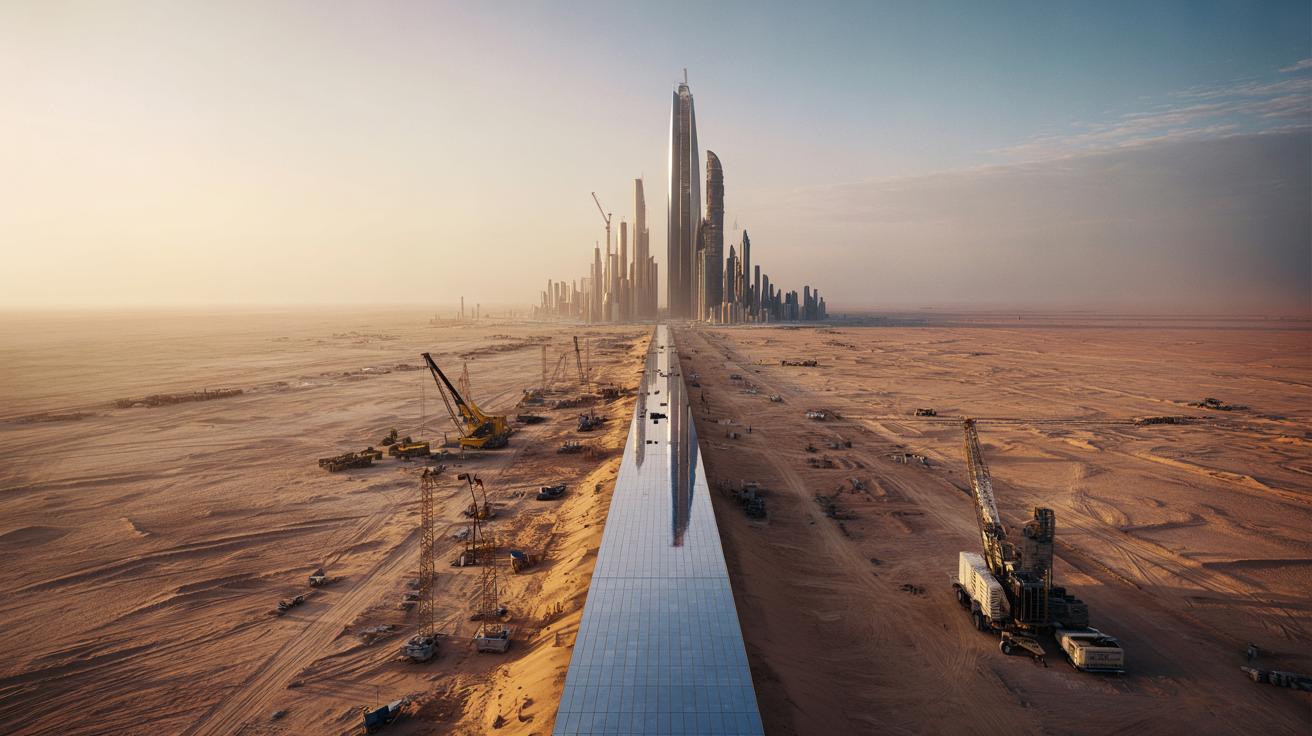
On the edge of Saudi Arabia’s Red Sea coast, the desert feels almost silent at sunrise. Only the rumble of trucks and the distant beep of forklifts break the stillness, scattered around a raw strip of land that was supposed to become the future: a 100-mile-long glass-and-steel megacity called The Line. For years, glossy renderings promised flying taxis, mirrored walls slicing the horizon, and nine million residents living in a zero-car paradise. Today, the reality on the ground looks… smaller. Fewer workers, fewer machines, the sense that someone quietly took their foot off the gas.
Saudi Arabia hasn’t slammed the brakes on its boldest dream.
But it has definitely downshifted.
From 100 miles of ambition to a shorter, sharper reality
When Crown Prince Mohammed bin Salman unveiled The Line in 2021, the pitch sounded like science fiction made real. A city just 200 meters wide, stretching 100 miles across the desert, running entirely on renewable energy and stitched together by high-speed transit. The promise was nothing less than a new way of living, away from sprawl and traffic, in a climate-controlled urban corridor of the future. The project sat at the heart of Vision 2030, Saudi Arabia’s plan to move beyond oil and reinvent itself as a hub for tourism, tech and global investment.
The scale was deliberate: it was supposed to be breathtaking.
On the ground though, the breathtaking part lately has been the bill. Analysts estimate that tens of billions of dollars have already been poured into NEOM, the wider mega-project hosting The Line. Satellite images show huge construction camps, excavation scars, and the first foundations near the coast. Yet sources close to the project say targets have been quietly revised.
Instead of a 100-mile city by 2030, internal planning reportedly focuses on a much shorter initial stretch, perhaps just a couple of miles, housing fewer than half a million residents, not the nine million once trumpeted.
The shift is about more than sand and steel. Global investors have been watching closely, weighing dreams against spreadsheets. Oil prices, which bankroll much of Vision 2030, swing up and down. Construction costs have spiked worldwide. Even for a country used to mega-projects, committing hundreds of billions on a single futuristic city starts to look risky.
Let’s be honest: even the most visionary government still has to balance a budget.
Why Saudi Arabia is quietly shrinking its desert dream
Behind the scenes, the logic is almost painfully straightforward: start smaller, spend less, prove it works, then expand. Officials close to NEOM have hinted that the first phase of The Line will focus on a compact “starter city” near the Red Sea, closer to existing logistics and tourism hubs. That means less remote infrastructure, fewer miles of utilities, and more controllable timelines. Think pilot project, not instant utopia.
➡️ Neither swimming nor Pilates: experts reveal the best activity for people suffering from knee pain
➡️ The forgotten bathroom liquid that brightens yellowed toilet seats effortlessly
➡️ Scientific breakthroughs in diabetes in mark a historic turning point in treatment
➡️ The conversation starter that makes anyone instantly like you (psychologists confirm this works)
➡️ Starlink Unveils Mobile Satellite Internet: No Setup, No New Phone Needed
This way, the government can showcase something real by 2030, without being crushed by its own ambition.
For many Saudis who followed the hype, the recalibration feels both sobering and oddly familiar. We’ve all been there, that moment when you sketch a huge plan on paper, then run into the limits of time, money, or energy. At first, The Line was sold as all-or-nothing, a 100-mile leap into tomorrow. Now, residents in nearby Tabuk see fewer recruitment drives, smaller construction crews, and talk of “phasing” replacing talk of “revolution.”
On social media, young Saudis swap memes about half-finished megaprojects, between genuine pride and nervous doubt.
From an urban planning perspective, the pivot actually makes sense. Building a single linear city longer than many countries is a logistical nightmare: every mile needs transport, water, power, cooling, waste systems. Each delay multiplies across the whole line. By scaling back, planners can test whether people even want to live in such a dense, vertical corridor, whether the climate systems really hold up in 50°C summers, whether jobs and culture follow.
*Dreams are easier to draw on a screen than to pour into concrete under a blazing sun.*
What this means for Saudi Arabia, investors, and the rest of us
If you look at it as a strategy instead of a retreat, the move is almost like a founder pivoting their startup before it implodes. Saudi Arabia is still pushing NEOM, still marketing luxury islands and ski resorts in the desert, still chasing tourists and tech entrepreneurs. The change is in tempo and scale. Build the first neighborhood of The Line, not the whole 100 miles. Attract the first wave of residents and companies, then use their feedback to tweak everything from public spaces to transit.
It’s slower, less cinematic, but arguably more realistic.
The emotional trap here, for leaders and citizens, is clinging too hard to the original burnished vision. When a country ties its identity to a single megaproject, any adjustment can feel like failure. Yet urban history is full of cities that grew in messy, improvised ways, not from perfect blueprints. The risk now is trying to save face with endless new promises instead of owning the pivot.
Investors can smell denial from a mile away, and everyday Saudis are already trading rumors faster than any press release.
Saudi urbanist and policy analyst Khaled al-Khatib summed it up bluntly: “**The Line was never just about a city. It was a symbol. Symbols can shrink a little and still matter, but they can’t collapse. What happens next will tell us if this is a mature adjustment or a warning sign for Vision 2030 as a whole.**”
- Watch the phasing: Are smaller sections delivered on time and actually inhabited, or do they sit empty?
- Follow the money: Do budget reports and state funds shift quietly away from mega-projects toward smaller, distributed investments?
- Listen locally: What do nearby residents, workers, and small businesses say about activity levels on site?
- Track foreign partners: Do big-name architects, tech firms, and hotel brands stay committed or quietly walk away?
- Look beyond the desert: Does Saudi Arabia double down on more modest, existing cities like Riyadh and Jeddah at the same time?
The future of big dreams in a world running out of patience
There’s a strange tension in watching Saudi Arabia scale back The Line. On one hand, it’s another reminder that mega-projects rarely unfold the way their launch videos promise. On the other, there is something undeniably human about refusing to give up entirely, even when the numbers bite back. This desert strip has become a kind of mirror: for how countries chase status, how leaders sell transformation, and how far the world is willing to go to reimagine life after oil.
The question isn’t just whether The Line will ever reach 100 miles. It’s what kind of future feels believable enough that people will actually move there, raise children there, build messy, ordinary lives behind those mirrored walls.
| Key point | Detail | Value for the reader |
|---|---|---|
| Scaled-back length and population | From a 100-mile vision with nine million residents to a shorter initial segment with far fewer inhabitants | Helps you gauge how seriously to take the original claims and what “success” now realistically looks like |
| Phased “pilot” approach | Focus on building and proving a compact starter city near the Red Sea before extending into the desert | Shows a more practical playbook you can recognize in other grand projects and investments |
| Signal for Vision 2030 | The Line’s slowdown reflects broader budget pressures, investor caution, and political risk | Gives you a lens to read future Saudi announcements beyond the glossy renderings and slogans |
FAQ:
- Question 1Is The Line project canceled?
- Question 2How much money has Saudi Arabia already spent on NEOM and The Line?
- Question 3Why is Saudi Arabia scaling back the 100-mile plan now?
- Question 4Will the scaled-down version still be open to foreign residents and tourists?
- Question 5What does this change tell us about the future of Vision 2030 and Saudi mega-projects?