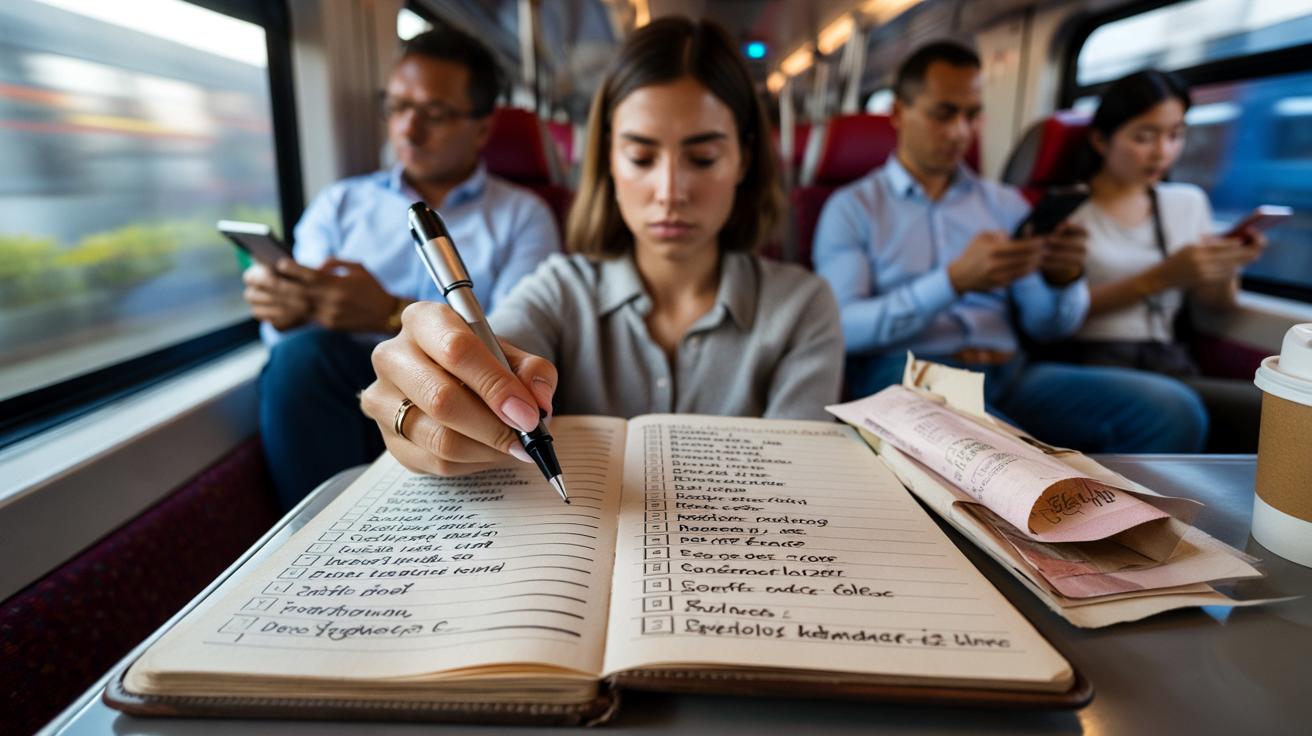
The woman in front of you on the train doesn’t look up once. While the rest of the carriage scrolls through glowing screens, she pulls a battered notebook from her bag, uncaps a pen, and starts writing a to-do list in neat, slightly slanted handwriting. Groceries. Call mum. Finish report. A small, private world of ink quietly forms on her lap.
Around her, notifications flash, Spotify playlists shuffle, someone plays a video too loudly. She doesn’t flinch. She pauses instead, crosses out a task with a sharp, satisfying stroke, and you can almost see the micro-dose of relief run across her face.
Why, in a world of productivity apps, are some people still loyal to paper?
Why some minds still reach for pen and paper
Psychologists say people who cling to handwritten to-do lists often share a deep need for concreteness. They don’t just want to plan; they want to see their day laid out in physical space. A list you can fold, crumple, leave on the kitchen table feels more “real” than a row of digital checkboxes hidden inside an app.
These are the people who like smelling books in bookstores, who remember phone numbers from childhood, who keep movie tickets and receipts in a drawer “just in case.” A handwritten list is part planning tool, part anchor. It grounds the swirl of mental noise into lines and bullets that you can literally hold in your hand.
Think of Anna, 34, project manager, juggling meetings, a side hustle, and a toddler who believes sleep is optional. She has tried every app recommended on TikTok: color-coded calendars, smart reminders, habit trackers that gamify brushing your teeth. For a week or two, she’s all in. Then the notifications start to blur together. The apps become cluttered, she stops opening them, and the old chaos returns.
One Sunday night she gives up, pulls a spiral notebook from a kitchen drawer, and writes the next day by hand. Meetings. Shopping. “Buy tiny socks (again).” The simple act of writing slows her down just enough to think. She sticks the list to the fridge with a magnet and, the next day, feels oddly less scattered. That list never buzzes or pings. Yet she respects it more.
Psychologically, that scene is not random. Handwriting activates different brain regions than typing. It boosts memory, focus, and emotional processing. People who still list by hand tend to be slightly more reflective, more sensory-oriented, and more attached to personal rituals.
They often show a quiet stubbornness against digital overload. They like to control the tempo of their attention rather than let a phone set the rhythm. Crossing off a task creates a visible history of effort that no “Completed” folder on a screen can match. For these people, productivity is not just about efficiency. It’s about feeling their own life in motion.
Nine personality traits hidden in a handwritten to-do list
If you look closely, those crumpled lists reveal nine recurring personality traits. You might recognize yourself in just a few, or almost all of them. First, there is usually a streak of quiet discipline. Not flashy, not “rise and grind” motivational-poster discipline, but a steady internal promise: if it’s on the page, it deserves a real attempt.
➡️ Neither swimming nor Pilates: experts reveal the best activity for people suffering from knee pain
➡️ New ban hitting wood burners announced as fireplace rules changed
➡️ The one winter fruit that keeps robins returning to your garden, according to birdwatchers
➡️ Starlink Unveils Mobile Satellite Internet: No Setup, No New Phone Needed
Second, these people often show a preference for autonomy. They don’t want an app telling them when to drink water or stand up. The list is theirs, and so is the responsibility. Third, there’s a taste for simplicity. Pen, paper, line, task. No dark mode, no sync error, no lost password. Just you and the day ahead.
A fourth trait: emotional awareness, even if it’s subtle. Many manual list-makers quietly adjust their tasks to their energy levels. On a tough week, they’ll write “Email three people” instead of “Clear inbox.” They sense their own limits and build them into the list.
Fifth, there’s usually a nostalgic thread. Not a desire to live in the past, but a fondness for the tactile: the weight of a notebook, the feel of the paper, the way ink thickens when you pause. Sixth, they are often visual thinkers. Seeing tasks in a column or scattered across a page helps them judge what a day really holds. A screen’s uniform layout doesn’t give the same intuitive read.
The last three traits are where psychology gets especially interesting. Seventh, people who write lists by hand often show higher perseverance. The physical effort of rewriting an unfinished task onto a new page makes them more aware of what is truly dragging on. That gentle friction pushes them to either do it, delegate it, or drop it.
Eighth, they value privacy. A paper list doesn’t live on a server. It can be brutally honest: “Stop texting your ex” can sit right next to “Pay electricity bill.” And ninth, there is often a small rebellious streak. While the world is obsessed with “productivity hacks,” they return to something simple and analog, trusting their own brain over yet another trendy system. *That little act of resistance says a lot about how they want to live.*
How to lean into your handwritten-list personality (without turning it into homework)
If you’re already a paper-list person, you don’t need a complicated method. Start with one small ritual: one list per day, on one physical surface. That could be a notebook, a notepad by the kettle, or a folded sheet in your pocket. Keep it visible. Let it quietly shape the day instead of hiding it away.
Write your tasks in the order they actually come to mind, then draw a short line between “must do” and “would be nice.” No fancy symbols needed. Let the messiness stay. The goal is not to create a Pinterest-perfect bullet journal. It’s to see your mind on paper, unfiltered, and gently organized.
A common mistake is turning the list into a moral scoreboard. You know that sinking feeling at 9 p.m. when half the page is still untouched. The temptation is to think, “I failed today.” That mindset kills the quiet magic of handwritten planning. Remember: a list is a tool, not a personality test.
Try this instead. When tasks roll over to the next day again and again, ask yourself: Does this really matter to me? Or is it there out of guilt, comparison, or habit? Let’s be honest: nobody really does this every single day. The people who keep writing lists long term are the ones who allow themselves to cross things out not because they’re done, but because they’re no longer worth their energy.
“On paper, your priorities can’t hide behind notifications,” says a clinical psychologist who uses handwritten lists with her patients. “The blank page gently asks: what actually deserves space in your day?”
- Honor small tasks
Write down tiny, real-life gestures like “drink a glass of water” or “open the window for five minutes”. They count more than you think. - Keep one “emotional line”
Add a single line each day for how you feel: tired, hopeful, bored. Over time, it explains a lot about why certain tasks get done or ignored. - Set a closing moment
At the end of the day, circle one thing you’re proud of, even if the list is still half full. - Accept imperfection
Messy handwriting, arrows, scribbles, coffee stains: that’s life happening on the page. It’s not a defect, it’s a trace. - Protect your privacy
If it helps you be honest, keep your notebook somewhere only you see. The safer it feels, the more authentic your lists become.
A small sheet of paper, a quiet act of self-knowledge
Once you start noticing them, you’ll see handwritten to-do lists everywhere. On café tables next to half-drunk lattes. On car dashboards, clipped under sun visors. In pockets, folded into quarters, with soft creases from being opened and closed all day. Each one is a snapshot of someone’s inner world trying to have a conversation with their outer life.
Psychology doesn’t romanticize this habit for nothing. People who write lists by hand often carry a mix of discipline, sensitivity, autonomy, and gentle rebellion that doesn’t show up at first glance. They want to remember, to choose, to slow down just enough to feel their own decisions. A phone can store a thousand tasks, but a single page can reveal who you are when nobody is watching.
Maybe that’s the real question these lists ask: not “What do you have to do today?” but “Who are you becoming, one crossed-out line at a time?”
| Key point | Detail | Value for the reader |
|---|---|---|
| Handwritten lists reflect deeper traits | They’re linked to concreteness, autonomy, and emotional awareness | Helps you understand what your planning style reveals about you |
| Simple rituals work better than complex systems | One visible daily list beats five abandoned productivity apps | Gives a realistic way to feel more in control without overwhelm |
| Imperfection is part of the process | Messy, half-finished lists still carry meaning and data about your life | Reduces guilt and encourages sustainable habits over time |
FAQ:
- Question 1Are handwritten to-do lists really better than apps?
- Question 2What if my handwriting is terrible – does that matter psychologically?
- Question 3Can I mix paper lists and digital tools without losing the benefits?
- Question 4Why do I feel guilty when I don’t complete everything on my list?
- Question 5How can I start a handwritten list habit if I always abandon systems?